
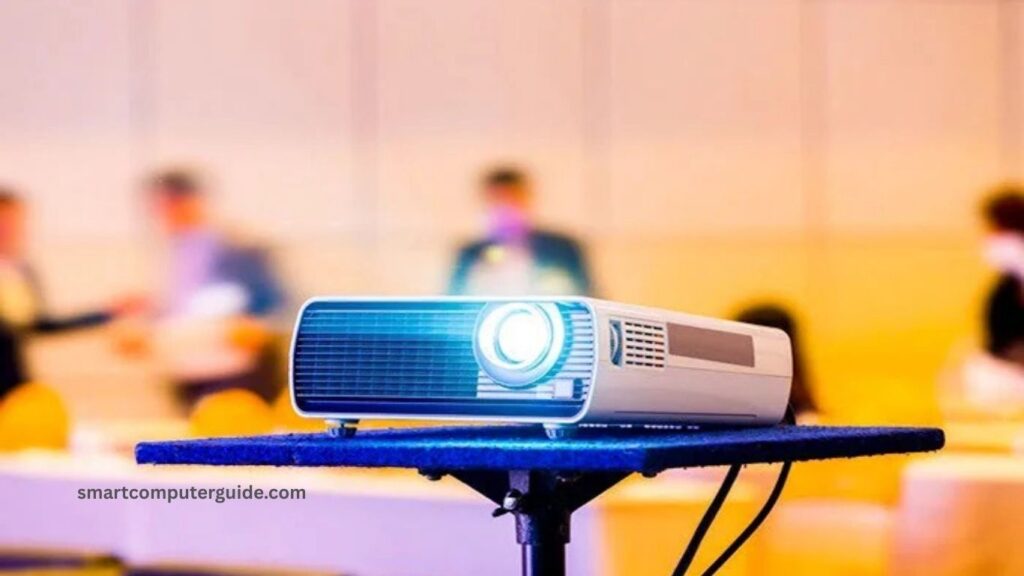
Imagine transforming any plain wall in your room into a massive cinema screen within seconds that’s the magic of a projector. This device takes images and videos and displays them on large surfaces, creating an immersive viewing experience that feels bigger and more engaging.
Whether for movies, presentations, or gaming, projectors make visuals come alive in a way that smaller screens cannot match. They are a key example of output devices, which are computer components that present information in visible or audible form. Learn more about these essential devices in our guide to computer output devices.
Read More: What is CPU? A Complete Guide
What is a Projector?
A projector is a device that displays images or videos on large surfaces like walls or screens. It receives input from computers, phones, or media players and uses light and lenses to project content. Commonly used in classrooms, offices, and cinemas, projectors make visuals bigger and clearer, allowing multiple viewers to see the content simultaneously. Simply put, a projector turns small images into large, easily visible displays, enhancing presentations, movies, and other visual experiences.
History and Evolution of Projectors
Projectors have a long history of helping people share images and stories with large audiences.
Early History & Magic Lantern
In 1420, Johannes de Fontana sketched a lantern that could project images. By the 17th century, the Magic Lantern became the first practical projector, using lamps and glass slides to display pictures on walls.
Motion Pictures and Overhead Projectors
In 1853, Edmond Becquerel created the first overhead projector. Later, Eadweard Muybridge’s Zoopraxiscope displayed moving pictures, laying the groundwork for movie projectors.
The Digital Era
The 1930s introduced CRT projectors, and the 1970s saw the first digital projectors. By the 1990s, digital projectors became common in schools, offices, and homes.
Modern Innovations
Today, projectors are smart, portable, and often Wi-Fi enabled. Laser projectors offer bright, clear images, while short-throw projectors display large visuals from small distances.
Types of Projectors
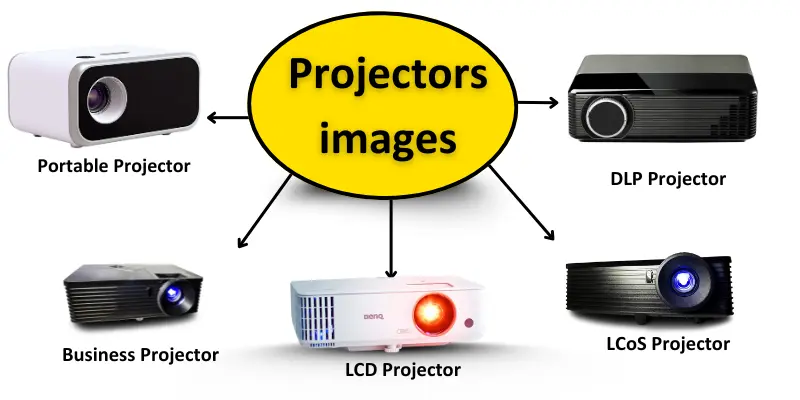
- Portable Projector: Easy to carry for movies or presentations.
- Business Projector: Bright, clear images for meetings and offices.
- Home Theater Projector: Big-screen movie experience at home.
- Short-Throw Projector: Projects large images from short distances.
- LCD Projector: Uses liquid crystal panels for clear images.
- LED Projector: Energy-efficient with long-lasting LED lights.
- Laser Projector: Bright, colorful images for large rooms.
- DLP Projector: Uses tiny mirrors for sharp visuals.
- 4K Projector: Ultra-high-definition images for movies or gaming.
- LCoS Projector: Smooth, realistic images using Liquid Crystal on Silicon.
- CRT Projector: Older cathode-ray tube technology.
- Gaming Projector: Fast, clear visuals for gaming.
- Projector TV: Combines projector and TV functionality for big-screen viewing.
Parts of a Projector
A projector has several key components, each working together to display images and videos clearly on a large screen:
- Lens: Focuses and projects the image onto the screen.
- Lamp/Light Source: Provides the brightness needed for clear visuals.
- Colour Wheel: Adds accurate colors to the projected image.
- Cooling Fan: Prevents overheating and ensures smooth operation.
- Power Supply: Supplies electricity to the projector.
- Control Buttons: Allow users to start, stop, and adjust settings.
- Ports/Connectors: Connect the projector to computers, TVs, or other devices.
- Projector Body: Protects and houses all internal components.
Uses of Projectors
Projectors make it easy to display images, videos, or presentations on large screens, ensuring everyone can see clearly.
- Education: Teachers use projectors to show lessons, videos, and presentations in classrooms.
- Business: Ideal for meetings, presentations, and training sessions.
- Home: Families enjoy movies, games, and big-screen entertainment at home.
- Cinemas: Projectors display films on massive screens for large audiences.
- Events: Used in conferences, weddings, and other gatherings to share visuals with attendees.
Advantages and Disadvantages of Projectors
Projectors enlarge images so multiple viewers can enjoy content at once. However, like any device, they have pros and cons.
Advantages:
- Displays large images for many viewers
- Portable and easy to carry (for some models)
- Ideal for movies, gaming, and presentations
- Modern projectors offer bright, clear visuals
- Compatible with computers, phones, and media players
Disadvantages:
- Requires a dark or controlled-light environment
- High-quality models can be expensive
- Needs regular maintenance (lamp, filter, etc.)
- Image quality may suffer in small spaces
- Some models produce fan noise
Frequently Asked Questions
What is a projector?
A projector is a device that displays images or videos on a large surface, such as a wall or screen, making visuals easily viewable by multiple people.
How does a projector work?
It takes input from a computer, phone, or media player and projects it using light, lenses, and sometimes a color wheel.
What are the main types of projectors?
Common types include LCD, LED, DLP, laser, short-throw, portable, home theater, business, 4K, CRT, LCoS, gaming, and projector TVs.
Where are projectors commonly used?
Projectors are used in classrooms, offices, homes, cinemas, conferences, weddings, and other large events.
What are the advantages of using a projector?
They provide large, clear images, are portable (some models), suitable for movies, presentations, gaming, and compatible with multiple devices.
What are the disadvantages of projectors?
They require controlled lighting, can be costly, need maintenance, may produce fan noise, and have limited clarity in small spaces.
What are the key parts of a projector?
Main components include the lens, lamp/light source, color wheel, cooling fan, power supply, control buttons, ports/connectors, and the projector body.
How have projectors evolved?
From the Magic Lantern in the 17th century to modern digital, LED, and laser projectors, technology has improved brightness, portability, and image quality.
Can projectors be used for gaming?
Yes, gaming projectors provide fast refresh rates, sharp images, and large displays for an immersive experience.
Conclusion
Projectors transform small images into large, immersive displays, making them essential for education, business, entertainment, and events. Modern projectors are versatile, portable, and compatible with multiple devices, offering bright, clear visuals for any audience. While they require controlled lighting and occasional maintenance, their benefits—enhanced viewing, large-screen experiences, and convenience—make them invaluable.