
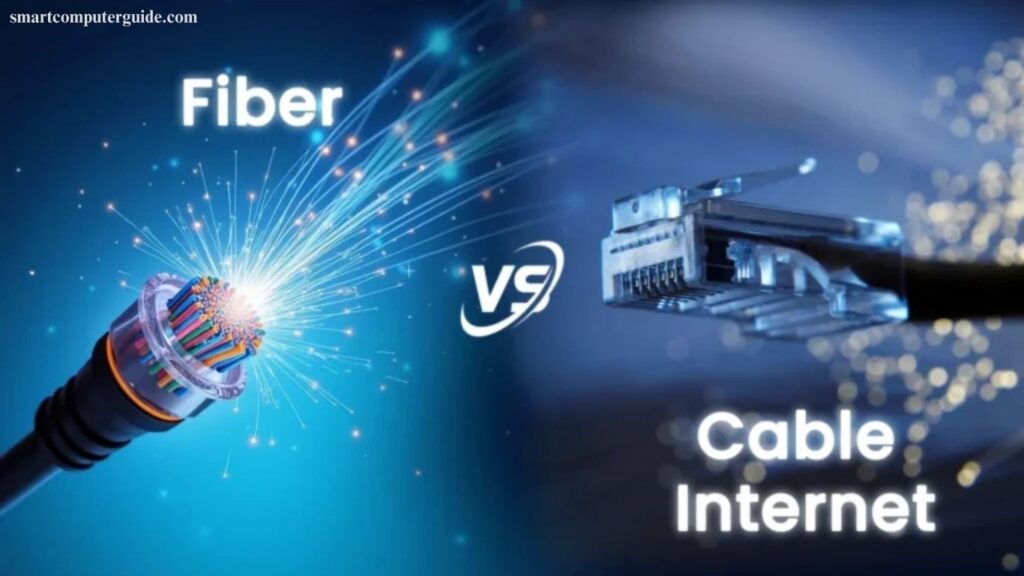
Choosing the right internet connection is crucial for speed, reliability, and overall online experience. Fiber and cable internet are the two most popular options, each offering distinct advantages. Fiber delivers ultra-fast speeds, low latency, and consistent performance, making it ideal for gaming, streaming, and remote work. Cable internet, widely available, provides stable connections at competitive prices and is suitable for everyday browsing and moderate streaming.
Understanding the differences in speed, cost, availability, and reliability helps you make an informed decision. This guide compares fiber and cable internet to help you determine which option best fits your needs.
Read More: Differences between internet and intranet
Technology Behind Cable and Fiber Internet
Cable internet reaches homes through coaxial wires the same technology used for cable TV. Its widespread adoption before streaming platforms helped cable achieve around 82% nationwide availability in the US.
Fiber internet, on the other hand, relies on fiber-optic cables, transmitting data as pulses of light. This allows for ultra-fast, symmetrical speeds, meaning upload and download rates are nearly identical. However, fiber is available to only about 43% of the US population. Expanding its network is costly, as fiber-optic cables are delicate and expensive to install.
How Cable and Fiber Internet Work
Both cable and fiber internet are wired connections, and their basic operation is similar despite technological differences. Internet signals travel through coaxial cables for cable internet or fiber-optic cables for fiber internet, reaching the modem in your home. The modem converts these signals into usable internet, which the router then distributes to your devices. This seamless process ensures all your electronics stay connected, whether you’re streaming, gaming, or working online.
Speeds Offered by Cable and Fiber Internet
Fiber internet outperforms cable in speed, offering symmetrical upload and download rates that range from 100Mbps to 50,000Mbps, ensuring a smooth online experience. It’s ideal for HD streaming, online gaming, and large file downloads.
Cable internet provides download speeds between 100Mbps and 2,000Mbps, with uploads from 10Mbps to 200Mbps—sufficient for most everyday activities. However, bandwidth is shared among nearby users, and providers may throttle speeds during peak hours, affecting performance.
Cable vs. Fiber Internet Pricing
Fiber internet is generally more expensive than cable. Cable plans typically range from $15 to $120 per month, while fiber plans start at $20 and can reach up to $900 monthly. The higher cost of fiber reflects the expensive infrastructure required for laying delicate fiber-optic cables.
Cable benefits from widespread existing infrastructure, keeping costs lower. Despite its price, fiber offers uncapped plans and often no long-term contracts, providing greater flexibility and value for heavy internet users.
Pros and Cons of Cable and Fiber Internet
Cable and fiber remain the top internet connection options today, each offering unique advantages. However, both come with drawbacks that users should consider before choosing the best fit for their needs.
Cable Internet
Pros:
- Widely available with near-nationwide coverage.
- More affordable than fiber plans.
- Options to bundle internet with TV, phone, or home security.
Cons:
- Speeds may drop during peak hours due to network congestion.
- Some plans include data limits or require contracts.
- Shared bandwidth with nearby users can affect performance.
Fiber Internet
Pros:
- Most plans have no data caps.
- Symmetrical speeds with equal upload and download rates.
- Extremely fast and stable, even during peak usage.
Cons:
- Higher cost compared to cable internet.
- Limited availability in certain areas.
- Fiber-optic cables are delicate and expensive to install.
Frequently Asked Questions
What is the difference between fiber and cable internet?
Fiber uses light in fiber-optic cables for faster speeds; cable uses coaxial wires with slower, shared bandwidth.
Which is faster: fiber or cable?
Fiber is faster, with symmetrical speeds up to 50,000Mbps; cable is slower and can be uneven.
Is fiber more reliable than cable?
Yes. Fiber maintains stable speeds even during peak hours; cable may slow down.
How widely available is fiber compared to cable?
Cable: ~82% coverage; Fiber: ~43% coverage in the US.
Does fiber cost more than cable?
Yes. Fiber plans are pricier due to infrastructure costs.
Can fiber handle multiple devices better?
Yes. Fiber supports multiple devices without speed drops.
Are there data caps on fiber or cable?
Most fiber plans are uncapped; cable may have limits or throttling.
Which is better for gaming and streaming?
Fiber, for fast, stable, and low-latency connections.
Conclusion
Choosing between fiber and cable internet depends on your needs and budget. Fiber offers unmatched speed, stability, and symmetrical uploads, making it ideal for gaming, streaming, and heavy usage. Cable is more affordable, widely available, and sufficient for everyday browsing and moderate streaming. Assess your location, devices, and online habits to decide which connection provides the best balance of speed, reliability, and cost for your home or office.