
AI in Computer Science: The Ultimate Guide explores how artificial intelligence (AI) is transforming the world of computing. From machine learning and natural language processing to computer vision and robotics, AI is reshaping problem-solving, decision-making, and innovation in technology.
This guide provides a clear understanding of AI concepts, practical applications, and future trends, making it accessible for students, professionals, and tech enthusiasts. Whether you’re looking to implement AI in software development, research, or industry projects, this resource offers actionable insights and expert knowledge to navigate the rapidly evolving field of AI in computer science effectively.

Read More: Software in Age of Digital Progress
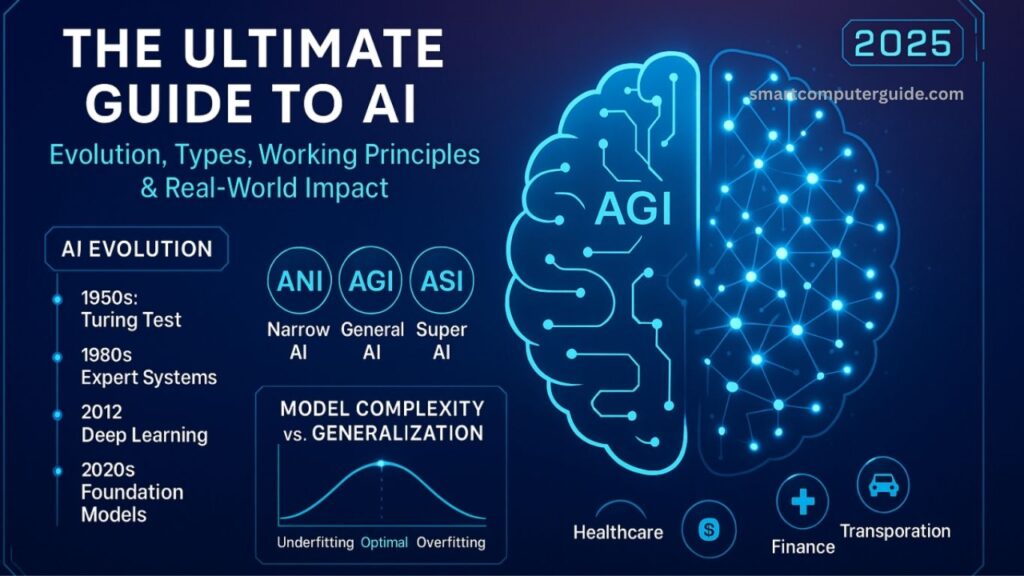
History of Artificial Intelligence
The history of AI in Computer shows how computers have evolved to become smarter. From early concepts in the 1950s to today’s advanced AI systems, this journey is marked by groundbreaking discoveries.
When and How AI Began
AI began in the 1950s with the goal of creating machines that could think like humans. Early efforts focused on teaching computers to solve simple problems and play games.
Key Milestones
The term “Artificial Intelligence” was first coined in 1956. By the 1960s, AI programs could solve math problems and play chess. The 1980s saw AI understanding language and supporting expert systems. Today, AI powers robots, smartphones, and self-driving cars.
AI’s Evolution
Over 70 years, AI has progressed from performing basic tasks to recognizing faces, understanding speech, translating languages, and making decisions. Modern AI makes computers faster, smarter, and more capable than ever.
How Artificial Intelligence Works
Artificial Intelligence (AI) enables computers to learn, reason, and make decisions by analyzing data through algorithms and models.
Data, Algorithms, and Models
AI relies on data to learn. Algorithms are step-by-step rules that process this data, while models use algorithms to predict outcomes and guide decisions.
Training AI Systems
AI systems improve through training. The more examples and data they receive, the better they recognize patterns and make accurate predictions over time.
AI’s Working Process
AI first collects data from its environment, then analyzes it using algorithms and models, and finally makes decisions, solves problems, or forecasts results efficiently.
Types of Artificial Intelligence
AI is categorized based on capabilities and functions:
Narrow AI (Weak AI): Performs specific tasks, like voice assistants.
General AI (Strong AI): Learns and thinks like humans.
Super AI: Surpasses human intelligence and makes advanced decisions.
Applications of Artificial Intelligence
AI enhances efficiency across daily life and industries:
- Education: Smart learning apps and tools.
- Healthcare: Assists in diagnosis and treatment.
- Business: Chatbots, sales predictions, and customer service.
- Daily Life: Voice assistants, smart homes, and content recommendations.
- Smartphones & Social Media: Face recognition, spam filtering, and personalized content.
Examples of AI
- Voice Assistants: Siri, Alexa, Google Assistant.
- Chatbots: Customer support on websites.
- Recommendation Systems: Movies, videos, products.
- Face Recognition: Unlock phones and identify people.
- Self-Driving Cars: Navigate roads safely.
Key Components of AI
- Data: The foundation AI learns from.
- Machine Learning: Enables AI to learn from data independently.
- Algorithms: Step-by-step instructions for solving problems.
- Neural Networks: Mimic the human brain for pattern recognition.
- Natural Language Processing (NLP): Understands and uses human language.
Advantages and Disadvantages of AI
Advantages: Saves time, reduces errors, works 24/7, handles large data, improves efficiency.
Disadvantages: High development costs, potential job loss, lacks emotions, data privacy issues, can make mistakes with faulty data.
Frequently Asked Questions
What is Artificial Intelligence (AI)?
AI is the simulation of human intelligence in computers, enabling them to learn, reason, and make decisions.
How does AI work?
AI works by analyzing data using algorithms and models to recognize patterns, make predictions, and solve problems.
What are the types of AI?
AI is categorized as Narrow AI (specific tasks), General AI (human-like intelligence), and Super AI (surpasses human intelligence).
Where is AI used in daily life?
AI powers voice assistants, chatbots, smart home devices, recommendation systems, face recognition, and self-driving cars.
What are the key components of AI?
AI relies on data, machine learning, algorithms, neural networks, and Natural Language Processing (NLP) to function.
What are the advantages of AI?
AI saves time, reduces human errors, works 24/7, handles large datasets, and improves overall efficiency.
What are the disadvantages of AI?
AI has high development costs, potential job loss, lacks human emotions, raises privacy concerns, and can make mistakes with poor data.
What is the future of AI?
AI will continue evolving, enhancing automation, healthcare, business, education, and creating smarter, more capable systems worldwide.
Conclusion
Artificial Intelligence has transformed the way we live, work, and interact with technology. From its early beginnings in the 1950s to today’s advanced systems, AI continues to evolve, making computers smarter, faster, and more capable. It impacts every sector, including healthcare, education, business, and daily life, while offering both opportunities and challenges. Understanding AI’s types, applications, and components helps us leverage its potential responsibly.